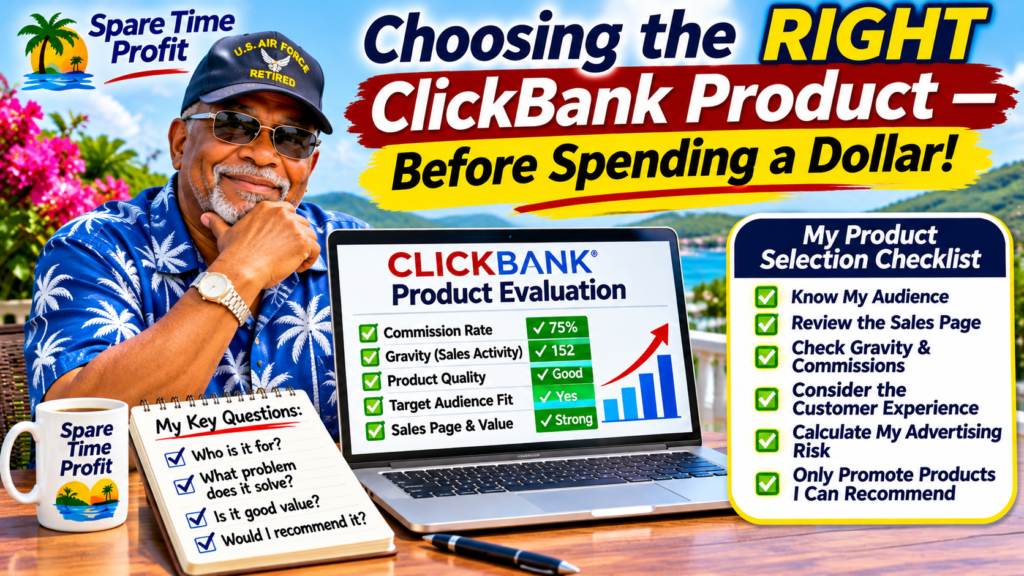

If you’ve been following my Spare Time Profit blog, you know that I’ve been sharing my experiences with ClickBank affiliate marketing, including the good results and the disappointing ones.
In my previous article, I explained how two separate solo advertising campaigns produced very different results.
My first campaign generated three sales, while my second produced none.
That experience reminded me of something important.
Before spending money on advertising, we need to make sure we’re promoting the right product to the right audience.
Today, I want to explain what I look for when evaluating ClickBank products and what I believe beginners should consider before investing in paid traffic.
Why Choosing the Right Affiliate Product Matters
ClickBank offers products in many different categories, including online business education, health and wellness, personal development, and other consumer interests.
But just because a product offers an attractive commission doesn’t automatically make it a good choice.
I’ve been involved in marketing for many years, including selling books, mailing lists, and printing services.
One lesson I’ve learned is that successful marketing starts with understanding what people actually want or need.
That same principle applies to affiliate marketing.
A product must offer something relevant to the people you’re trying to reach.
1. I Start With the Audience, Not the Commission
One of my main interests is helping beginners, particularly retirees and people looking for practical ways to earn additional income in their spare time.
That means I want to examine products that may be useful to those readers.
For example, beginner-friendly online business training may be more relevant to my audience than an expensive advanced marketing system.
Before selecting an offer, I ask:
- Who is this product designed for?
- What problem is it supposed to solve?
- Would a beginner understand how to use it?
- Is the price reasonable for the intended audience?
If I cannot clearly explain who would benefit from a product, I probably need to do more research before promoting it.
2. I Examine the Product’s Sales Page
A product’s sales page can tell you a great deal about how the vendor communicates with potential customers.
I look for clear explanations of what the customer receives.
I also pay attention to whether the sales page makes exaggerated promises.
For example, I’m cautious about offers that suggest someone can earn large amounts of money immediately without effort, experience, or risk.
I prefer realistic explanations, transparent pricing, and clearly described benefits.
A good sales page should help customers make an informed decision.
3. I Review the ClickBank Marketplace Information
ClickBank provides marketplace information that can help affiliates compare offers.
One metric worth understanding is Gravity, which reflects recent affiliate sales activity according to ClickBank’s calculation.
A product with a higher Gravity score may have evidence of affiliate sales activity, but that doesn’t guarantee it will convert well for my particular audience.
Likewise, a product with a lower score isn’t automatically a bad product.
I believe these numbers should be treated as research tools rather than guarantees.
I also want to understand the commission structure, potential recurring payments, and whether the offer includes additional purchases.
4. I Consider the Customer’s Experience
This is one area I want to pay even more attention to.
What happens after someone purchases the product?
Does the customer receive clear instructions?
Is support available?
Are the refund terms understandable?
Does the product deliver what its sales page promises?
Whenever possible, I prefer to examine the product itself, available demonstrations, independent customer feedback, and vendor support information.
I don’t want to recommend something simply because the commission looks attractive.
A disappointed customer may remember the person who recommended the product.
That is why trust matters.
5. I Calculate the Advertising Risk
My recent solo advertising experience reinforced the importance of this step.
Before purchasing another advertising campaign, I want to estimate how many sales would be needed to recover my costs.
Here’s a simple example.
Suppose an advertising campaign costs $100 and the affiliate commission is $50 per sale.
I would need two completed, non-refunded sales just to recover the $100 advertising expense.
Three sales would produce $150 in commissions, leaving $50 before any other expenses.
But if the campaign produced no sales, I would lose the $100 advertising investment.
This is why I believe beginners should start with small, affordable tests rather than spending large amounts of money hoping for quick results.
6. I Look for Products That Fit My Blog
Spare Time Profit is not intended to become a website that promotes every product available online.
I want to develop several useful categories that reflect my interests and experiences.
Affiliate marketing education is one category.
Other areas I intend to explore include retirement-friendly online business tools, travel, and emergency preparedness.
For example, emergency power and preparedness are especially relevant to people living in the Caribbean, where storms and electrical reliability can be major concerns.
However, I want each category to contain useful educational articles, not simply advertisements.
Readers should understand why a product is relevant before they encounter a recommendation.
7. I Ask Whether I Would Feel Comfortable Recommending the Product
This may be my most important consideration.
Would I feel comfortable explaining this product to a friend, family member, or fellow retiree?
Would I be willing to discuss its disadvantages as well as its benefits?
Could I explain the total cost without hiding important details?
If the answer is no, I should think carefully before recommending it.
I would rather build a smaller audience that trusts my recommendations than attract large numbers of visitors with exaggerated promises.
What I Plan to Do Differently Going Forward
As I continue my ClickBank journey, I intend to become more selective.
Instead of constantly searching for the next product to promote, I want to focus on offers that fit my audience and provide reasonable value.
I also plan to improve my tracking so I can better understand which products, advertising sources, and articles produce meaningful results.
Most importantly, I want to keep sharing what I learn.
Some experiments may work.
Others may not.
But I believe both experiences can provide useful lessons.
Final Thoughts
Choosing a ClickBank product should involve more than looking for the highest commission.
It requires understanding your audience, examining the offer, considering the customer experience, and evaluating the financial risk.
I have learned that getting traffic is only part of affiliate marketing.
Selecting a worthwhile product is another important part.
And building trust with readers may be the most important part of all.
If you’re just starting your affiliate marketing journey, my advice is simple:
Do your research first. Spend carefully. Track your results. And never promote a product solely because it promises a large commission.
Thank you for following my Spare Time Profit journey.
Interested in Learning More About ClickBank?
I’m continuing to learn through the ClickBank Profit Club training program.
If you’d like to explore the program and decide whether it’s appropriate for your goals, you can visit the link below.
Learn More About ClickBank Profit Club
Affiliate Disclosure: I may earn a commission if you purchase through my link, at no additional cost to you. This article is educational and does not guarantee income or business success.